 Prana Path
Trataka for Beginners: A Gentle 7-Day Plan
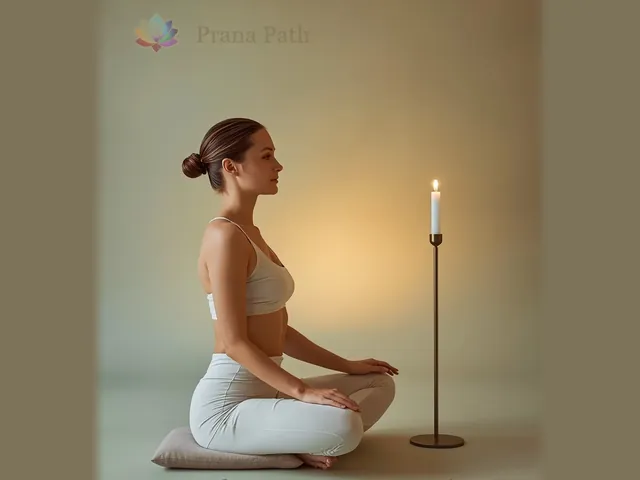
Trataka (steady gazing) is a simple focus practice from the yoga tradition. You look softly at one point, such as a candle flame. This 7-day plan starts with one minute a day, so you can build the habit slowly and gently.
This is general wellness information, not medical advice. Read our health disclaimer.
What Is Trataka?
Trataka (steady gazing) means resting your eyes on one object. Most people use a candle flame. Some people use a dot on the wall. Meditation is a wide family of practices, and some of them ask you to hold your attention on a visual image [1]. Trataka fits that description. Many types of meditation began in Eastern traditions. Trataka (steady gazing practice) is one of them [1].
Why Try Candle Gazing as a Beginner?
Many beginners find it hard to sit and watch the breath. A flame gives your eyes a clear job. Your mind has something simple to follow. Meditation practices are used to calm the mind and support overall well-being [1]. Trataka is not a cure for anything. Think of it as a quiet pause in your day. You can also read our guide to Trataka (Candle Gazing) for more detail.
Before You Begin: Set Up and Stay Safe
Sit in a quiet room. Place a candle at eye level, about an arm's length away. Keep it away from curtains, paper, and drafts. Never leave a burning candle alone. Meditation and mindfulness are usually seen as having few risks [1]. Still, stop if your eyes hurt or you feel dizzy. If you have an eye condition or any health worry, ask your doctor first.
Your 7-Day Trataka Plan
Keep each session short. On days 1 to 3, gaze for one, two, and three minutes. On days 4 and 5, add a short breath pause at the end. On days 6 and 7, build up to five minutes. Whenever your mind wanders, bring it back to the flame without blame. Mindfulness means noticing the present moment without judging it [1]. A wandering mind is normal, not a failure.
How to Finish Each Session
When time is up, close your eyes. Watch the glowing image of the flame in your mind for a few breaths. Then rest your palms over your eyes for a moment. You can also try Bee Breath (Bhramari), a humming breath practice, or Alternate Nostril Breathing (Nadi Shodhana), a calming breath practice. Both pair well with a quiet focus practice like this one [1]. After that, sit still for a minute before you stand.
Keep It Balanced: A Lesson from the Gita
The Bhagavad Gita (a classic Indian text) speaks about balance in verses 6.16 and 6.17. In simple words, it says steady practice works best when food, rest, work, and play are all moderate. That advice suits trataka well. Do not stare for too long or push through discomfort. Short, regular sessions are enough. Meditation takes many forms, and gentle practice is the aim [1]. You can also read our Bhagavad Gita Meditation (Dhyana) guide, or try Walking Meditation (Chankramana) on a rest day.
Try it: simple steps
- Day 1: Gaze softly at the flame for 1 minute, then close your eyes.
- Day 2: Gaze for 2 minutes. Blink whenever you need to.
- Day 3: Gaze for 3 minutes. Keep your shoulders relaxed.
- Day 4: Gaze for 3 minutes, then take five slow breaths.
- Day 5: Gaze for 4 minutes. Notice when your mind wanders.
- Day 6: Gaze for 5 minutes, then rest your palms over your eyes.
- Day 7: Gaze for 5 minutes, then sit quietly with your eyes closed for 2 minutes.
Questions people ask
How long should a beginner practice trataka?
Start with one minute a day. Add a minute every day or two, up to five minutes. Short and regular sessions work better than long, tiring ones.
Is trataka safe for beginners?
Meditation practices usually carry few risks [1]. Be careful with the flame, and stop if your eyes feel sore. If you have an eye problem or any health concern, talk to your doctor first.
Do I have to stare without blinking?
No. Beginners should blink whenever they need to. Keep your gaze soft and relaxed. Never strain your eyes to prove anything.
What can I use if I do not want a candle?
You can gaze at a small dot on a plain wall at eye level. The idea is the same. You rest your eyes on one simple point.
What is the best time of day for trataka?
Choose a calm time, such as early morning or the evening. Pick a time you can keep each day. A quiet room matters more than the exact hour.
Sources
- NCCIH: Meditation and Mindfulness - Effectiveness and Safety · U.S. National Institutes of Health
Written with AI assistance from the sources above, then checked for copied text and risky health claims. How we write
Practise it here
Related reading
This is general wellness information, not medical advice. Move slowly, never force a pose or a breath, and stop if you feel pain, dizziness or breathlessness. If you are pregnant, have high blood pressure, heart, lung or eye conditions, or recent surgery, ask your doctor before starting.